No bullying intended, I swear!
Background
I view the Multicellular Stage as having two major trends:
- Cell specialisation: Moving towards each cell type having one specific function
- Tissue formation: Placing cell types together to cooperate (these areas will then be converted into tissue blobs in macroscopic)
For today, I would like to look at number 1.
Cell specialisation has been mentioned quite often as a “given” for this stage, but I don’t recall seeing a lot of speculation on how and why a player would actually want to specialize their cells. In fact, I’ve for example seen streamers skip the concept entirely, and you can make it out of the current prototype perfectly fine without worrying about it.
Some things are easy to imagine. For example, a pilus isn’t going to do anything on a cell that is entirely surrounded by your own other cells. Might as well save the bit of osmoregulation and reproduction cost, right? But if we look at real life organisms, cells are usually extremely specialised, even when there are multiple functions they could perform in their location. For example, each cell in our skin could in theory easily make its own melanin. But instead, we have specialised melanocyte cells that only make melaninin-containing melanosomes, and then deliver them into other cells. Quite a bizarre arrangement, when you think about it.
While I would love to hear the opinions of the Theory team on this, as far as I can tell, the exact reason are still unclear. As King apparently put it:
The transition to multicellularity that launched the evolution of animals from protozoa marks one of the most pivotal, and poorly understood, events in life’s history.
From there in combination with some other sources, the best I can conclude is something along the lines of “doing less things in one cell is more efficient”, whether that be from not having as much of the DNA exposed to damage, or not having to rewire and remodel the cell every time you have to do something else.
The Suggestion
How I would like to model this efficiency is then deceptively simple:
Give a numerical performance bonus to each cell part, based on the percentage of the cell’s hexes that are taken up by this cell part.
As an example, having a cell that is 50% just spikes gets a 50% reduction in spike osmoregulation cost. (balance numbers… pending)
There are than two general effects I can imagine for this bonus:
- Osmoregulation cost reduction for everything.
- A different bonus selected for each cell part.
Personally I favour option 2, because I find it more interesting from a gameplay perspective.
Some examples for this option:
- A cell that is 50% vacuoles: 25% more storage per vacuole.
- A cell that is all flagella and mitochondria to power those flagella: Lots of speed, and the mitochondria get increased process speed to keep up with the increased energy demands of the flagella.
I think this mechanic would work very well to encourage players to specialise their cells (as long as it is made obvious to them), and since there are very significant numerical effects, I am hoping it will be relatively easy to make auto-evo aware as well. We also don’t have to be too careful with not making the bonuses too strong, because we want there to be a very strong incentive to heavily specialise cells, as seen in nature.
Some other random related points:
- I would exclude the Nucleus (and maybe the Binding Agent) from the “hex usage”% calculation, because it takes up a lot of hexes and is in every cell without choice. It would essentially just dilute the effects of the system.
- This does not necessarily have to be limited to just the multicellular stage, it could apply to microbes as well, giving some bonuses for specialisation in lifestyle. Though in this case, since it is much easier to have a prokaryote with just one type of organelle, I would make the bonus initially weaker, and only become stronger when you place a Nucleus and/or Binding Agents.
If people like the general idea, I can draw up a list of potential effects for each current cell part we have.
Edit: There’s also an alternative, more extreme version I thought of:
Instead of looking at hex usage, we look purely at the number of different types of organelles.
The benefit is that it strongly encourages total specialisation, with no one thylakoid left somewhere that you don’t need. (Also might be more realistic in that way, the cell not having to spare any effort on something at all is far bigger than doing something less)
The downside is that there’s no clear benefit to gradual specialisation if you don’t remove whole types of organelles from a cell type at once.
Of course, a combination is also possible: One bonus for proportion of hexes dedicated to one thing, and a separate final bonus for reducing the number of different organelles in a cell. But that might be layering on too many mechanics.
(Again, would also help make specialised microbes a bit stronger.
So, that list for potential effects for each organelle. (If we indeed go for unique effects instead of a generic bonus that is the same for each).
Firstly, we have a category that is still simply an osmoregulation cost reduction. Either because there are no other numerical values to act on, or because there are numbers, but they don’t make sense to act on:
- Chemoreceptor (numbers like detection range are something you want to have control over. Boosting them makes no sense.
- Perforator Pilus (I don’t think upping the damage of individual pili based on their proportion makes logical sense).
For most cell parts, it is actually quite simple. The category “just increase Bioprocess Speed”:
- Chemoplast
- Chloroplast
- Ferroplast
- Hydrogenase
- Hydrogenosome
- Melanosome
- Metabolosomes
- Mitochondrion
- Nitroplast
- Rusticyanin
- Thermoplast
- Thermosynthase
I think for some of the prokaryotic cell parts it makes sense to focus on just their primary objective, instead of the incidental ATP production. The category “Increase Bioprocess Speed, like above, but ignore Glycolysis”:
- Chemosynthesizing Protein
- Nitrogenase
- Thylakoids
Now for the slightly more complicated and perhaps more unique cases:
- Bioluminescent Vacuole: Increase Bioprocess Speed, so more ATP into more… light. Which sounds wasteful for now, but I would also boost the bonus it gives to oxygen resistance.
- Cilia: Increased bonus to rotation speed.
- Cillia (Pulling): Increased range and/or strength of pull while engulfing.
- Cytoplasm: Actually quite interesting. According to the previous pattern, could just give this a Bioprocess Speed upgrade. But, this is more commonly used (I think) to quickly get to a larger size (and sometimes get storage). So I could see a combined Osmoregulation cost reduction/Bioprocess Speed/Storage increase bonus here, or focus on just Osmoregulation cost reduction (with or without storage).
- Flagellum: Increased speed, equally increased ATP usage.
- Lysosome: Increased contribution to Digestion Speed and Efficiency.
- Slime Jet: Increased Bioprocess Speed, but also equally shoots out mucilage faster for more speed.
- Slime Jet (Mucocyst): Increased Bioprocess Speed. I think doing anything like to further enhance its defensive abilities might move balance in the wrong direction.
- Toxin Vacuole: Increased Bioprocess Speed, but perhaps also further increased fire rate that each organelle gives.
- Toxisome: Like above, but explicitly don’t boost the glycolysis.
- Vacuole: Increased storage.
The exempted:
- Binding Agent: Obviously you have one in every cell in multicellular. I would just ignore its hex in the “percentage of hexes dedicated to each organelle type” calculation. It could also increase the bonuses from this whole system (if the system is present pre-multicellular).
- Nucleus: Like above, but even more strongly because the large number of hexes is a big distortion on the system.
- Signalling Agent: Really, the only difference with the Binding Agent is that it can be removed. So, its hex could be included in the calculation so that you only keep it in one cell. It could even get the Osmoregulation cost reduction. This way, it could be worth it to make one cell somewhere of a cell type that only has the signalling agent and just enough energy to keep it going.
I think the above should be pretty decisive in enforcing the “cell specialisation” trend of the multicellular stage. That leaves the other trend: the formation of tissues of one or a few cell types in concentrated locations.
But since it is relevant to both that and the earlier discussed part, I first have an intermezzo:
The Beginning point of The Multicellular Stage
The trends I named have a lot of bearing on where the stage could end at. But of course, the start is relevant to how they function as well.
“Start with one cell and add differentiated cells gradually afterwards (both in the first time you enter the editor, and every time you leave the editor” has served very well for the prototype up until now, but I don’t think it fits as a definitive solution for the final product.
Firstly, from a theory perspective, there are several different hypotheses on the origin of multicellularity. For example, free-swimming cells coming together to form colonies, and cells failing to fully separate after division have both been proposed. (Both also have observational evidence in species living today) And this is Thrive, so we’re technically not locked to what “really happened” on earth. However, from what I can tell universally, complex multicellularity (with cell differentiation) arose from simpler colonies.
Secondly, there’s a similar situation going on in our microbe stage build-up to multicellular right now: First you add the binding agent, form colonies, and then you become multicellular (currently requiring a certain colony size). And as far as I remember, the plan was to add more steps to colony gameplay before you get to the multicellular editor.
All that is to say that I think it’s not fitting for a player/species to go from playing in a colony, to go back to being a solitary cell (that can’t even form colonies anymore), until you add in cells yourself. Instead, at least for the fully mature members of the species (like in the editor), you should start off with an organism made up of several (initially identical) cells.
For example in a layout similar to choanoflagellate colonies (extremely likely to be what the precursor to IRL animals looked like):
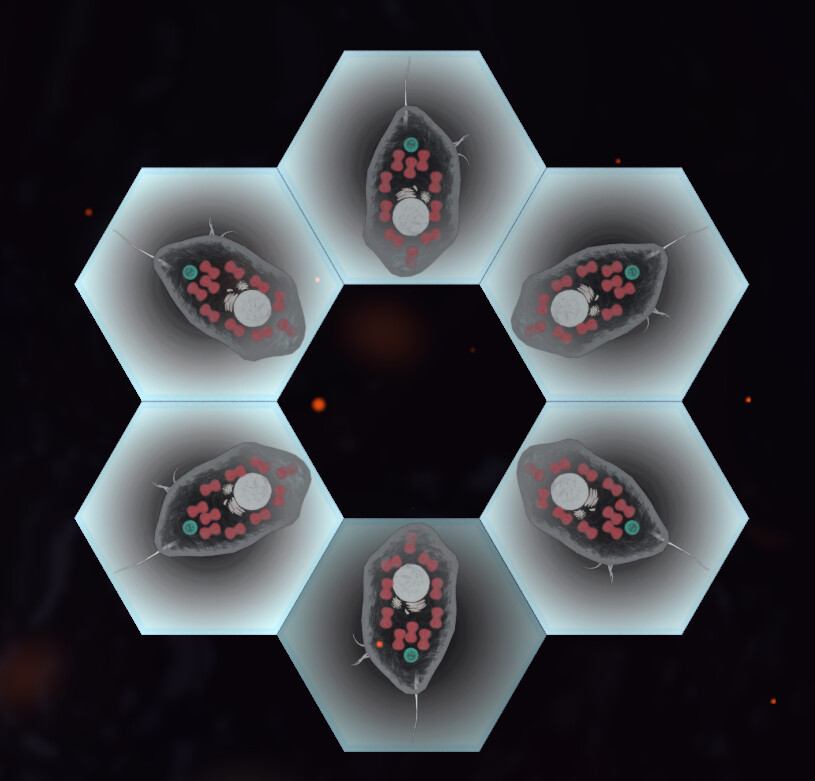
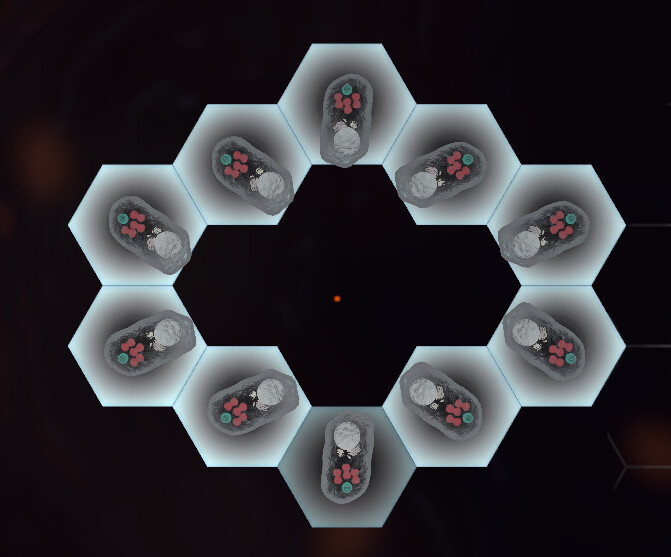
Those who are familiar, might also be reminded here of the blastula, one of the earliest stages in animal embryo development.
Or, if we don’t want to start with a central gap:
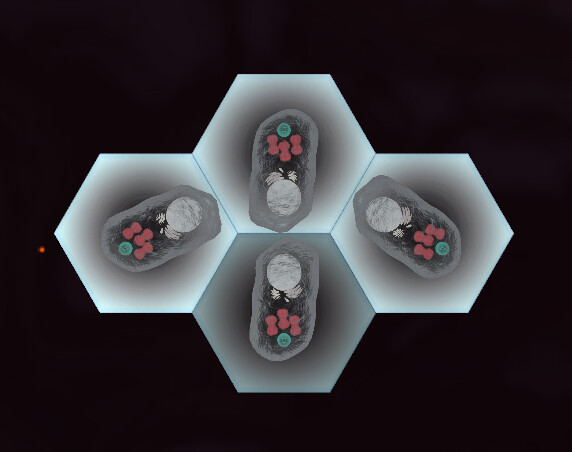

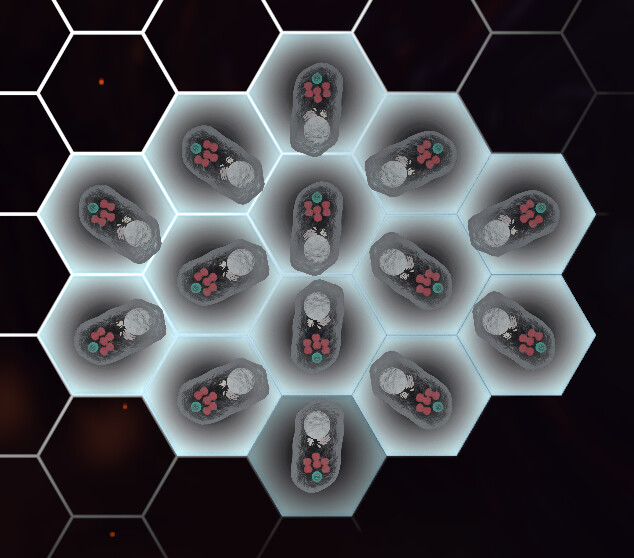
Of course, we can also have different starting layouts, I am thinking possibly based on cell walls. For example if the above is for normal membranes, this could be for cellulose:


(Though that’s probably violating my own rule of “don’t force a connection between two biological traits just because they are in the same creature on earth”. So it’s better if we find another way to determine that choice of starting layout.)
If we don’t want any pre-determined structure, a chaotic blob of randomly smashed together cells would actually also be fine. The important part is that you start with an organism that’s an unspecialised colony of cells, not going back to a single cell.
I think this will help place the player’s focus where it should be: you’re not going to “add more cells until you reach the size requirement to go to macroscopic”. You’re going to reshape your undifferentiated blob and specialise its parts (the two trends I mentioned before) until you arrive at a more complex organism that can grow to macroscopic scales.
This directly relates to the cell specialisation bonuses mentioned above: You start out with a bunch of unspecialised cells, and you can immediately start specialising by deleting unneeded organelles from certain cells that don’t need them. But, as you may have guessed, this works best with some changes to the editor as well.
The Multicellular editor
The core of the multicellular editor, editing cell types derived from other cell types and then making an organism out of those cells, is in my opinion solid. In relation to the previous section though, I think it would be ideal to have some added functionality to it.
Cell replacement
In particular, a way to specialise cells that are already placed. This could be in the form of a selection in the right-click menu on placed cells, or letting you place new cell types on top of others (akin to placing organelles on top of cytoplasm). I am not sure which of these is easier to implement, but either of these would work. The important part is that this should be cheaper in MP than deleting a cell and then placing a different cell type in the same place. I do think, especially with the new starting point I outlined above, this is a necessary mechanic to make it play smoothly.
As a corollary to this: I also think you should only be able to save a celltype as long as there is at least one cell of that type in your organism. I think making lots of edits to a cell that doesn’t even exist, for future use, goes against the objectives of Thrive.
Non-cell elements
I would say this part may not be strictly necessary, but it’s definitely a matter of questioning how accurate we want Thrive to be to reality. As you might have seen in diagrams of those choanoflagellate colonies, that gap in the middle of the sphere can be filled with a big glob of extracellular matrix. Lots of (simple) animals have large chunks of the body that are not really made up of cells. Cnidaria (yellyfish, corals, etc.) have Mesoglea, a gel-like skeleton that takes up much more space than the actual cells of the animals. Sponges have Mesohyl, which is very similar. Then you have things like shells, bones, the stony structure of corals, etc.
Technically these kinds of elements could be left to macroscopic (where they would really become necessary). But I think there is value in adding them here already.
As for how this would work in practice:
These would be listed separately from cell types in the main editor screen when available. They would be placed on a hex in the same way as a cell. They can only fulfil very limited functions, but because they’re not living cells they don’t cost much upkeep. Functions could be low upkeep storage, a tough outer shell, a place to farm bacteria, etc.
As for when they would be available:
This would depend on the cell types in your organism. For example, the binding agent would unlock “glob of extracellular matrix” (meaning this is available from the start). The slime jet/mucocyst could unlock a permanent slime layer. This system could even be expanded so that you can only place these non-cell parts next to a cell that can produce them. I think that would be a fairly interesting mechanic for players, but am not sure if this would be too much work to implement.
Cell membrane type
Something that could encourage the use of the above structures: I think there’s a good argument to make it so that once you hit the real multicellular stage, your membrane type should be locked, or at least forced to be uniform across all cell types.
While within IRL organisms there’s quite some variation between cells in the exact composition of their membranes, when we’re talking about the major types implemented in Thrive, as far as I have seen, these are universally consistent across entire organisms. Normally I say that we don’t need to stick to earth patterns for the alien life in Thrive. But the fact that this is such a consistent rule indicates to me that this is a valid restriction to put on players. And not, as this is now the case, varying membrane types between cell types being a very cheap and easy option that I see used quite frequently. From a biological perspective, I can also imagine that the methods an organism evolves to stick their cells together are probably quite dependent on how those cells’ membranes are built.
This then gives players new choices to make, on how to deal with this restriction.
For example, to bring this back around to the previous part: If you’re a single-membraned organism and you want a defensive layer, you don’t have the option of creating cell type with a silica membrane (which I currently do sometimes), but instead you need to place non-cell “shell parts”.
Another restriction would be that multicellular organisms with cell walls cannot become engulfers, because they can no longer create a different cell type without a cell wall just for engulfment.
Symmetry
This came up in discussion about the macroscopic editor as well. And it’s just a question about whether we want this choice to take place in multicellular, macroscopic, or both.
At it’s base this can build on the current symmetry button we have, but it’s more involved in gameplay. In short: symmetry should be a deliberate choice you make somewhere along the line. Once you’ve made it, you’re stuck with it, so you have to keep your organism (mostly) conforming to the symmetry. But, there’s a big payoff: the extra cells being placed or modified, do not cost MP. So you can make much larger changes at once, in exchange for being forced to have more regularity in our shape.
As I said before, this could either be skipped here and saved for macroscopic, be an option in either (and carried over in between), or even be one of the requirements before advancing. This all depends on what we imagine the organisms on either side of the the stage transition to truly represent.
I will come back to this post later on, with proposals on the second of the two trends: making sure multicellular ends with more or less cohesive tissue blobs that can be translated to macroscopic.