I want to try to nail down some more concrete numbers here for the scale of the game. The metric I am using here is the longest dimension of the organism. Measuring everything relative to the smallest organism, the single hex LUCA, is the goal here.
Here is for a scale that has been modified to have a narrow range while still seeming relatively realistic: (Using more upper bounds on realism)
10um- LUCA
100um- Eukaryote (Typical size)
500um- Multicellular Group (Typical size)
1mm- Small 3D Animal
This scale is a good approximate fit for what is currently implemented in the microbe stage. If LUCA is defined to be 10um in radius, then an average minimum Eukaryote at end of Microbe stage seems to be around 60um (6x LUCA) and the average minimum Multicellular group seems to be around 400um (40x LUCA).
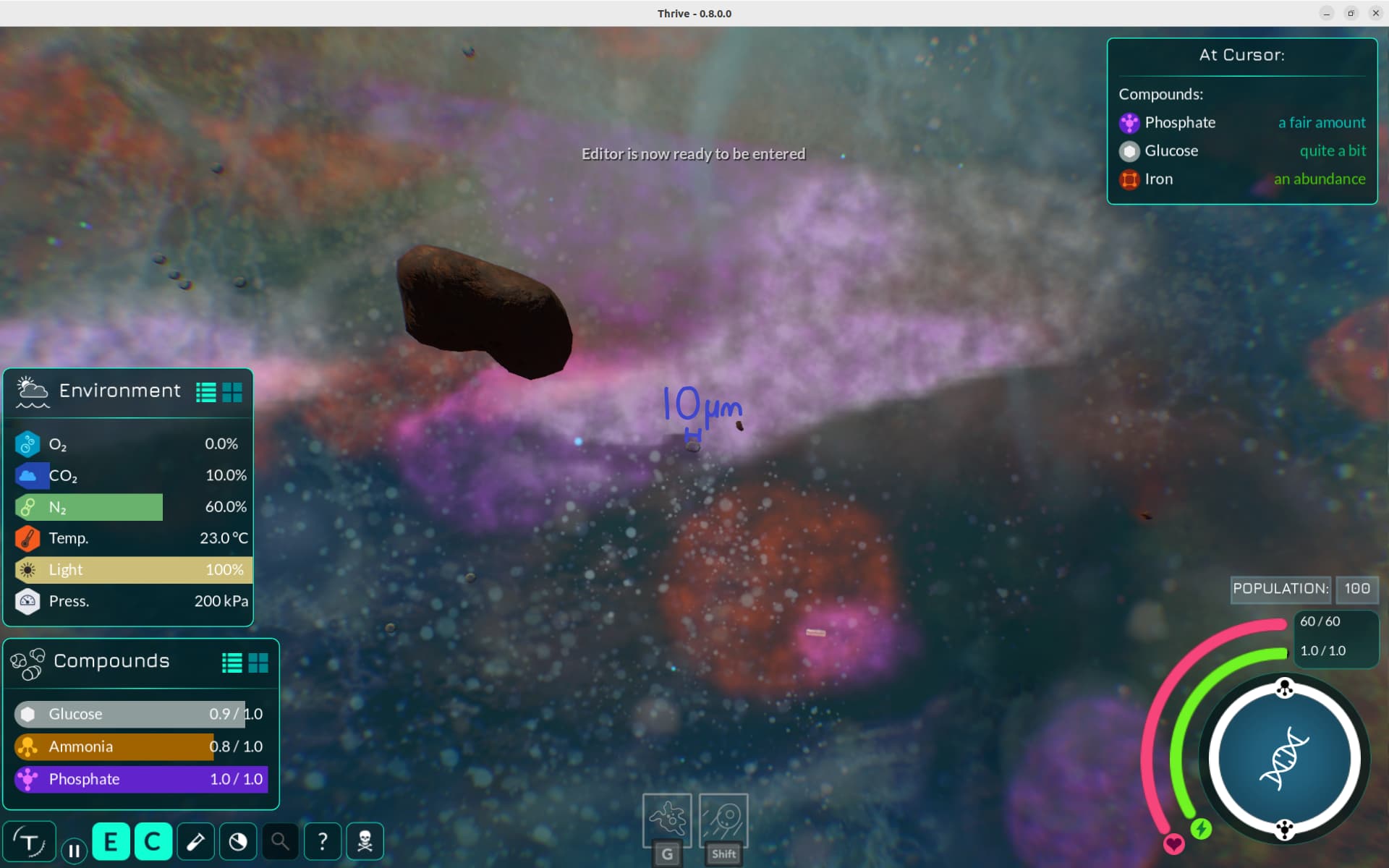
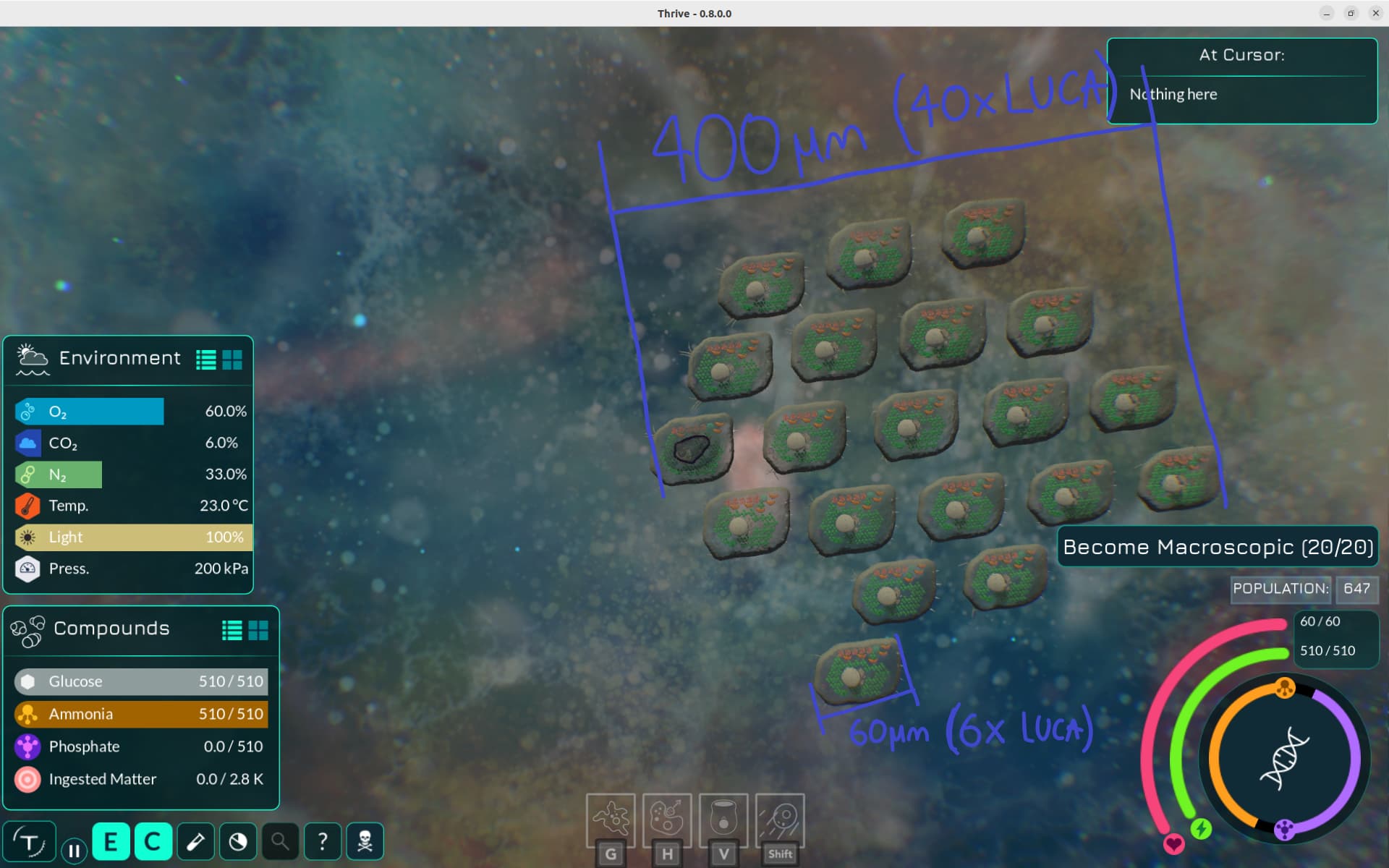
This does however imply that a 1mm scale for the jump to Macroscopic would be a far better fit than a 1cm scale. Going from 500um Multicellular to 1mm Macroscopic would be a reasonable jump of only 2x, which I believe would be continuous enough to seem reasonable for that transition. Going to a 1cm scale Macroscopic organism would instead be a jump of 20x, which seems like it would break the continuity of the stages.
On the initial transition to Macroscopic, if we want the experience to be continuous we are required to bring over the single celled organisms and Multicellular clusters in some form, otherwise the new 3D environment will be completely barren. I don’t think immediately replacing all microbes with abstract clouds will be a good enough solution, as that would be too close to just having the Macroscopic stage be like a new game disconnected from the rest of the game so far. And how would the Multicellular clusters be handled? Would they all be forced into Metaball based 3D organisms upon transition to Macroscopic? If they are reimplemented as cell clusters in 3D, then you might as well implement the individual microbes as well.
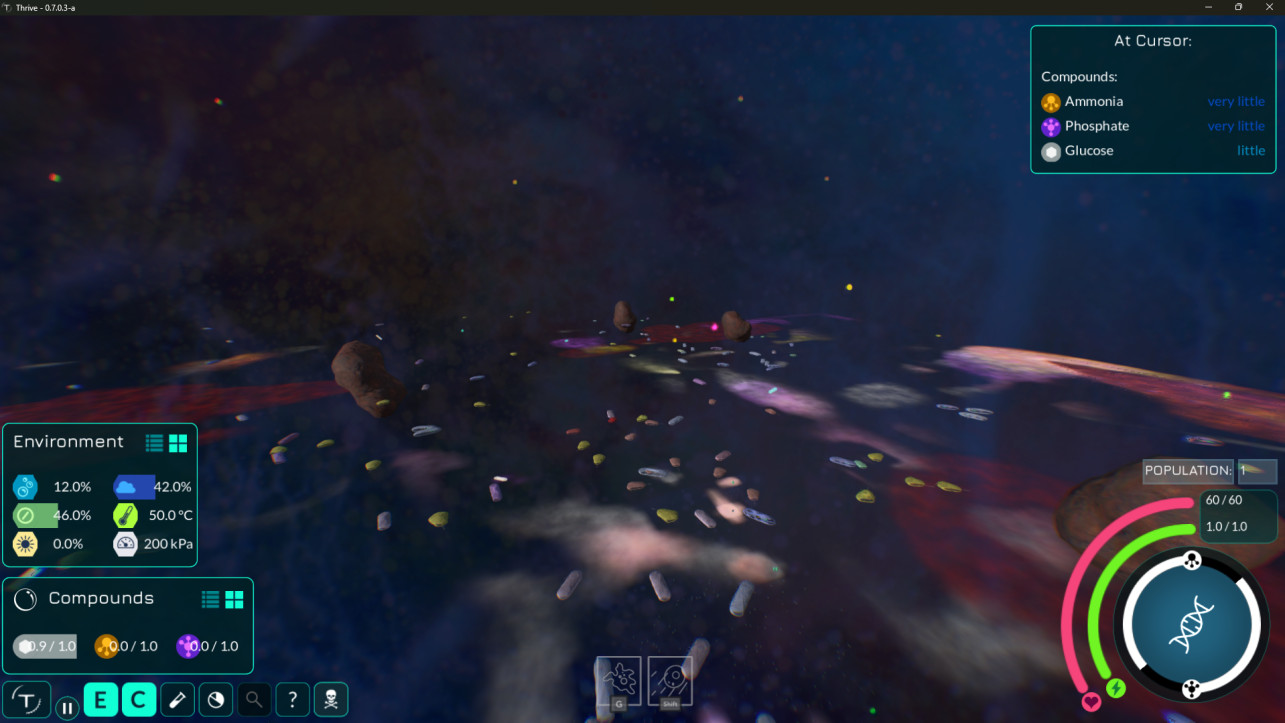
It seems like the better idea would be to reimplement a simplified version of individual Microbes in 3D. Since they will be small, they could be reduced to simple rigid membranes with reduced AI capabilities likely without loss of much noticeable detail. These would be approximations of the microbes just like clouds of microbes will be, but they are a transition step while the microbes are too small to have much individual complexity anymore, but too individually large to be reduced to a generic cloud.
I don’t think it will take too much effort to do the graphics for the 3D Microbes, as we already have a good base for that, it would just need to be simplified further and tweaked. Aaronmkerch already gave us an example of this with his first person perspective mod:
We will need to implement a robust LOD system anyway to work with the greatly varying scales of organisms in the 3D stages. If we did use 1cm as the minimum size Macroscopic organism then the difference in scale with the largest organisms at 10m would be a difference of 1000x. This is the same 1000x difference as LUCA at 10um compared to the 1cm Macroscopic minimum. We would need to create this system anyway, so we might as well also use it at the beginning of Macroscopic to have better continuity with the previous stages organisms. Having low LOD approximations of single celled organisms and multicellular clusters seems far easier than approximating the full metaball based Macroscopic organisms, and could serve as a good practice for when we have to do this for the more complex Macroscopic organisms.
(I picked 10m as a lower bound for largest organism. This is about the size of T-Rex at 9m, but still smaller than most whales, let alone the Blue Whale at 30m. This would only increase the minimum supported scale differences)
Also, to fully make my point, even if we were able to squeeze in the entire Macroscopic range of 3D organisms without having to have different LOD of organisms at different scales, once the Society stage is reached then the scale will increase yet again. Unless we want to chop up the different stages into discrete jumps in scale thus breaking continuity between them every time, we will need to have a consistent solution for transitioning between scales across all the stages.