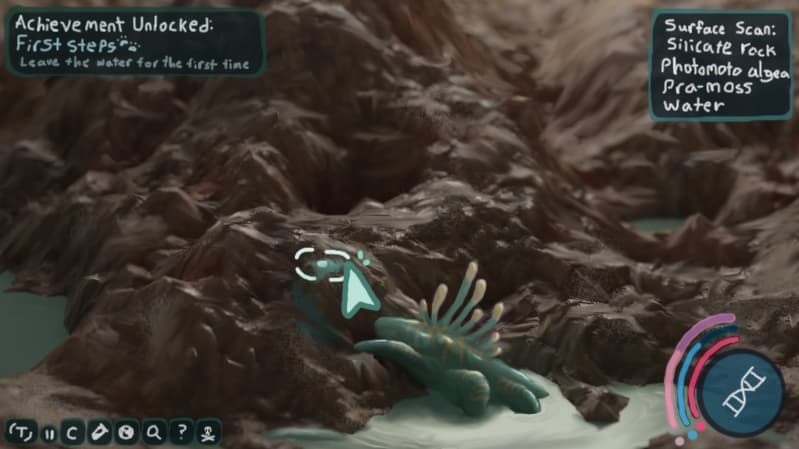
Macroscopic 3D Artstyle

With macroscopic development stage getting closer and closer, I think we should talk about how we want this stage to look like and clear out some basic concepts.

Color palette

In each playthrough, where planet is randomly generated, auto evo develops different creatures and random events happen, it would be very important to make sure that players will get a somewhat decent color palette.
First of all it’s important to understand what exactly would influence it:
Patch and planet

  • Depth → How much light reaches the location and thereby determines how strong light sources are in the patch. Think bioluminescence being more noticeable in deep sea than shore.

  • Compounds and minerals → While compounds won’t be as visible as in microscopic (there won’t be any visible ammonia clouds), they could still influence the minerals present in the patch, but because the majority of minerals that can be found on the surface are mostly grey, white or brown,

  • Turbidity → Turbidity would be directly influenced by the currents. Think muddy rivers and clear open waters.


    Anyone who played subnautica knows how important it is, just take a look at the crash zone and how easily it creates the atmosphere of danger

  • Events → Events such as asteroid impacts could increase turbidity as well as spawn some special rocks (Let people see the meteor that turned the whole planet into a snowball!). Overall players have to not only feel the event, but also see it in some way.

  • Type of light → If we are still implementing the different types of chloroplast that work with different light waves, type of light would have direct influence on any photosynthetic organism in the area.

Organisms

  • Sessile organisms (such as plants, bacterial mats and organisms feeding of symbiotic bacteria) would have the biggest contribution to the overall color scheme in the majority of the patches. Their color in turn would depend on patch factors mentioned above, especially depth and type of light.
  • Auto - Evo creatures: This part is a little tricky, because creatures will be more affected by sessile organisms instead of patch properties. The most simple example would be creatures developing camouflage or developing crests to stand out from the rest of the patch.

Auto - Evo
With these criteria in mind, we should still be able to provide a unique gaming experience for each player, we don’t want every world look the same. Of course we could just allow auto - evo do it’s thing and randomize the colors, but unless we want auto evo animals look like this:


we would need to set some limits.
First of all, less is more. Animals shouldn’t be allowed to have more than 3 highly different colors. If we would have a patch with many different creatures color palette could quickly go from this

to this

which isn’t optimal. So I suggest that we limit the usage of colors to 3 highly different colors with 1 color being the dominant one.

Second aspect that needs attention is how saturated we want auto evo to get? In my opinion limiting auto - evo’s usage of colors won’t be very realistic and would leave players without coral reefs. Instead of that auto - evo could use factors as camouflage by comparing animal to the color of the surroundings (plant life or sediment based on life style).
Won’t it mean that eventually we would reach a state where creatures are the same color as their patch? While it is a possible outcome, supporting some colorful structures would outweight their punishment in other ways, for example reproductive rate or communication.

In addition it would add an aspect of color to the equation, limiting the migration possibilities for coral reef dwelling creatures.

Player
If player want to play as rainbow colored worm, they should have all the rights to do so. The same rules of auto - evo would apply to them too however, maybe they would become a more frequent target of the predators, but overall having fun playing game would be the first priority rather than designing a boring creature.

Thoughts t on Textures
It is still not exactly clear to me how we are going to add textures to the metaballs, but I just want to share that really easy way to create somewhat realistic skin texture that is extremely simple:

7 Likes

Good on you to start this thread, and good material here. Though development is now focused on the Multicellular Stage, we are getting close to development for a complete shift in how Thrive is played. So organizing material is always a good idea.

Color Palette

In my opinion, Thrive’s color scheme should be slightly more muted than it is vibrant - atleast for the environment.

This is largely because of personal taste of course, but I think Thrive will naturally be representing slightly untraditional game scenes in the 3D stage; vast spaces of a natural environment, with varied amounts of flora. Environments will, atleast for a decent chunk of the Macroscopic and Early Aware Stages, represent a world where flora and fauna don’t have a big imprint on their world yet. Things will be sterile, rocky, and alien in many ways in certain areas.

Emphasizing that with a more muted color scheme could show how impactful life is on a planet as it expands. It could also make later portions of the Aware Stage pop more if fauna is more extensive. Muted colors are also seen as more naturalistic too.

I think muted colors would also be useful for organisms too just because we will likely have some weird looking creations. Even if we create a really aesthetically appealing editor/sculpting style, there will still inherently be a level of blobiness, roughness, and lack of detail in organisms. Spore embraced this by having a more stylized and cartoony design, but we can’t swing very much in that direction - so slightly muted colors on organisms could help reduce this effect a bit. Quite like your concept of the organism at the bottom of your post.

Here are some really cool concept art pieces with muted colors. Note that I don’t think the game should universally be this desaturated - vegetation and animals should bring some color, and should have a bit more contrast so that players can track shapes better.

5 Likes

One topic I am kind of missing here is the connection between the art of the Microbe/Multicellular stages, and everything after. To borrow words from Deus I would say that in these stages the environment is quite muted, with exceptions like pyrite, while life is really quite vibrant.

Now I am not saying the 2D and 3D need to look the same, but is all part of one game, so there should be a noticeable unified vision between them.

One of the hypotheses does say that green pigment is pretty good at absorbing the right amount of light without overloading under earth conditions. If we take that one one as truth, we can indeed say “under X light spectrum, thylakoids have Y colour”, without needing gameplay mechanics for several different pigment colours to pick between.
(Basically, ignore that even on earth we have several different rarer photosynthetic pigments used under different circumstances like ocean depths. But I suppose even if we have for example a “depth-optimised” upgrade, that colour could also be generated the same way)

I do wonder how easy it would be to change the colour of thylakoids and macroscopic metaballs per planet like that?

I want to emphasise my agreement with this. We want the possibility to have:

Colourful life


It also seems to me that there are quite many forms of life that just seem entirely unconcerned with the need for camouflage, even without specific needs to be visible. Probably want to keep that in mind for auto-evo also.
Besides that, I am not sure if this was included in your thoughts, but: Lots of compounds that life needs for other purposes than visibility just happen to have colour. Indeed various photosynthetic pigments, but also protective pigments, the heme in your blood and muscles (and other blood colours), etc.

Or less frequent, if they also happen to be poisonous…

I don’t disagree, but there is also an argument for the opposite: if you are going to spend a considerable amount of time in barren landscapes, those barren landscapes better be visually interesting to look at by themselves as well.

Also:

Do note that by the time you enter Macroscopic, there’s going to be quite a lot of life, just that it will be quite microbial. That does not mean a lack of vibrant colour necessarily though:

Colourful microbes


As noted before, I do think we should also also want cases of very vibrant colours, perhaps as exceptions, but still there. But I think exactly how vibrant life gets (on average and at maximum) should be relatively easy to tweak along the way?

Is this the case? Naturalism is all about depicting things as they are without exaggeration, but that does still mean bright colours when they are real:

1 Like