Yes! This is a pretty good start, though I do have some suggestions and concerns.
On Integuments:
First of all, I figure different types of integuments (and possibly skins as well) could be handled with different tissues – perhaps different from tissues used to sculpt the main volume of the body, so you can’t accidentally fill your insides with a rolled-up mass of skin or something. (ew)
And also this would make skin an integumentary tissue (it’s in the name after all) that the player would have to evolve to protect their insides from the elements.
As tissues, they might also have to be unique in that they can create structures made of cells or dead material on top of them…though it would be interesting for internal tissues to have these capabilities as well. (Could be used to create support structures made of nonliving material for cells?) Coats with different pigmentation could simply be represented by similar tissues that make structures with different pigments, so some areas could be “painted” in different integumentary tissues to create patterns of differently-colored fur, for example.
This system would lead to a lot of very similar tissues. Even without differently-pigmented versions of the same type of fur, for example, a lot of different integumentary tissues would be based on the same “skin” layer. If I were making some multicolored fluffy animal, I wouldn’t want to manually make a skin tissue, a skin with red fur tissue, a skin with yellow fur tissue, a skin with blue fur tissue, etc…
Perhaps tissues could be organized in some sort of tree, where they inherit some of the properties of their parent. So bare skin would be the base, and skin with all the different colors of fur would be based off of that (or perhaps the player could even make one “default” skin with fur tissue, and all the others only differ by which pigments are produced!)
This could get very complicated to set up though. Edits to some base tissue might be so big that they break all others based on them, and even if they don’t, just getting normal changes to carry through the entire tree could be tricky on its own. It also might not be very intuitive.
Another solution is closer to your idea, which is to have “growths” like fur, feathers, setae, and possibly scales (i feel like we need a better word for these, since integuments does usually refer to to skin. Just “coats” again maybe?) added as an extra layer on top of skin – so you could have different regions of both soft and tough skin, different integumentary tissues, and you could tell both to start growing the same type of hair.
The difference is that your suggestions of a full coat, clumps, and pigmentation would all be handled by this. A full coat would be a layer of one type of growth painted on every surface of the body (maybe with a fill bucket kind of tool, haha) while clumps would be smaller areas of types different than their surroundings. Differently-pigmented areas would be handled by simply painting different types of growths in different areas.
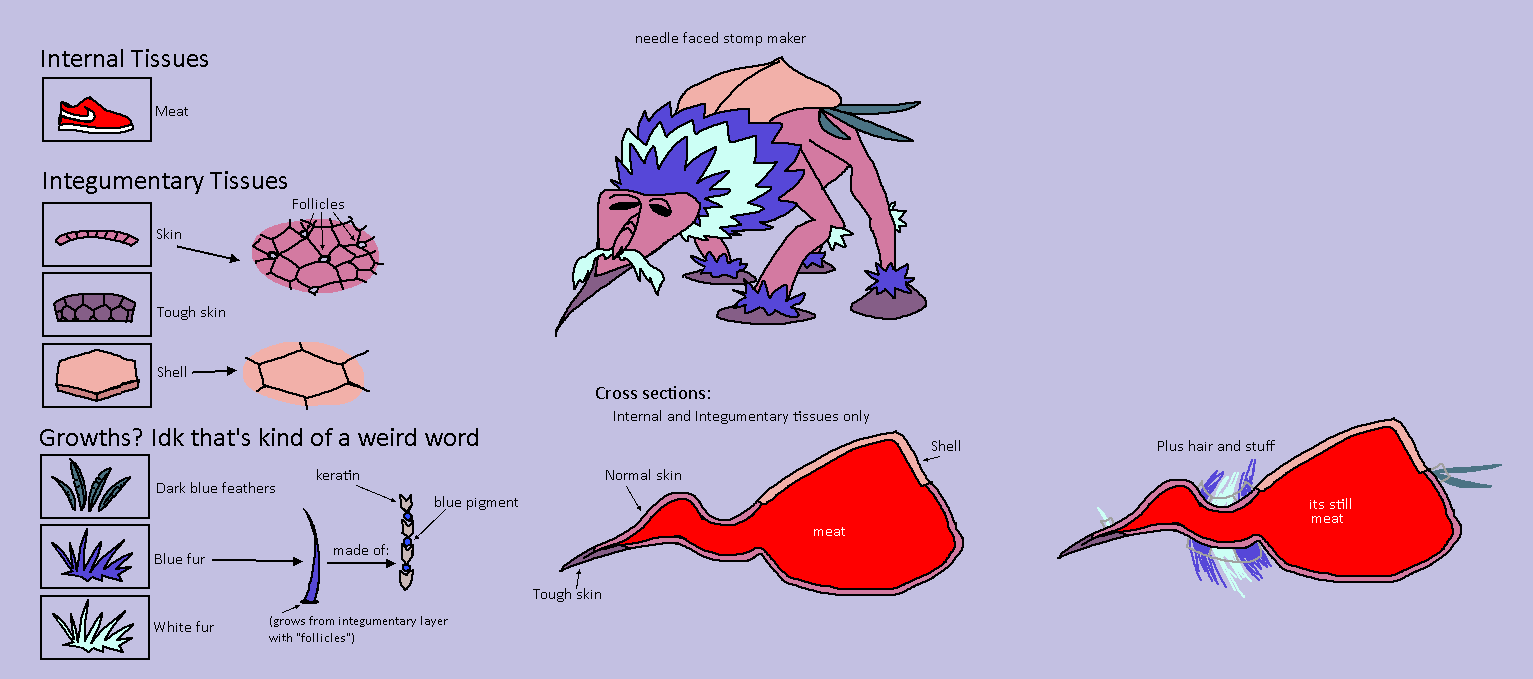
Working on this concept, I realized that some integumentary layers, like the shell here, wouldn’t/shouldn’t allow “fur” to be painted on top of them. Though, would a shell even be in the same category as skin? It’s probably made up of mostly dead structures, and in some cases it might be on top of the skin, but it’s also structurally totally different from fur and feathers and scales. In some cases it might even be an extension of the skeleton, like in turtles…
Maybe shells would be considered to be in the same category as skin, for simplicity and intuitiveness’ sake I suppose, meaning there needs to be a way for players to create integumentary tissues of tough, likely dead material like it. And it’s up to the player whether or not to include “follicles,” or places fur and stuff can grow, in each of their integumentary tissues. Including them grants the ability to add fur, feathers, and scales, which can be very useful, but adding them to something like a shell may compromise its strength (or be a useless addition, given the location)
The density of something like fur would be dependent on the density of follicles on the skin tissue it is based on, which could require an unintuitive and unpleasant trip out of the fur editor/painter, and into the skin tissue editor. Then, changing the follicle density would also change the density of fur everywhere else on the organism’s body, unless the player made a new skin tissue, which would probably just be the exact same as the other except with a different follicle density… so it’s probably best to have fur/growth density controlled in the editor for said fur/growth, or the brush used to paint them.
As for slime, I feel like it will have to be handled separately as a secretion, possibly similar to agents in a way.
On layers and structure
This is also a good place to start! Though some might see the abdominal layer as being too close to how Spore does things, I think it’s ultimately reasonable to have a “core” to anchor the organism to.
The abdominal region could vary a lot between different organisms. If could be compact and rigid, with lots of extra appendages branching out from it, or long and flexible with few extra parts to speak of, like a snake or worm.
We do need to remember to not make things too animal-centric, though. How would organisms like grass and other plants work? The editor in general needs to be ready to handle asymmetric organisms, and not force bilateral symmetry or even a “front” until the player has developed bilateral symmetry and cephalized.
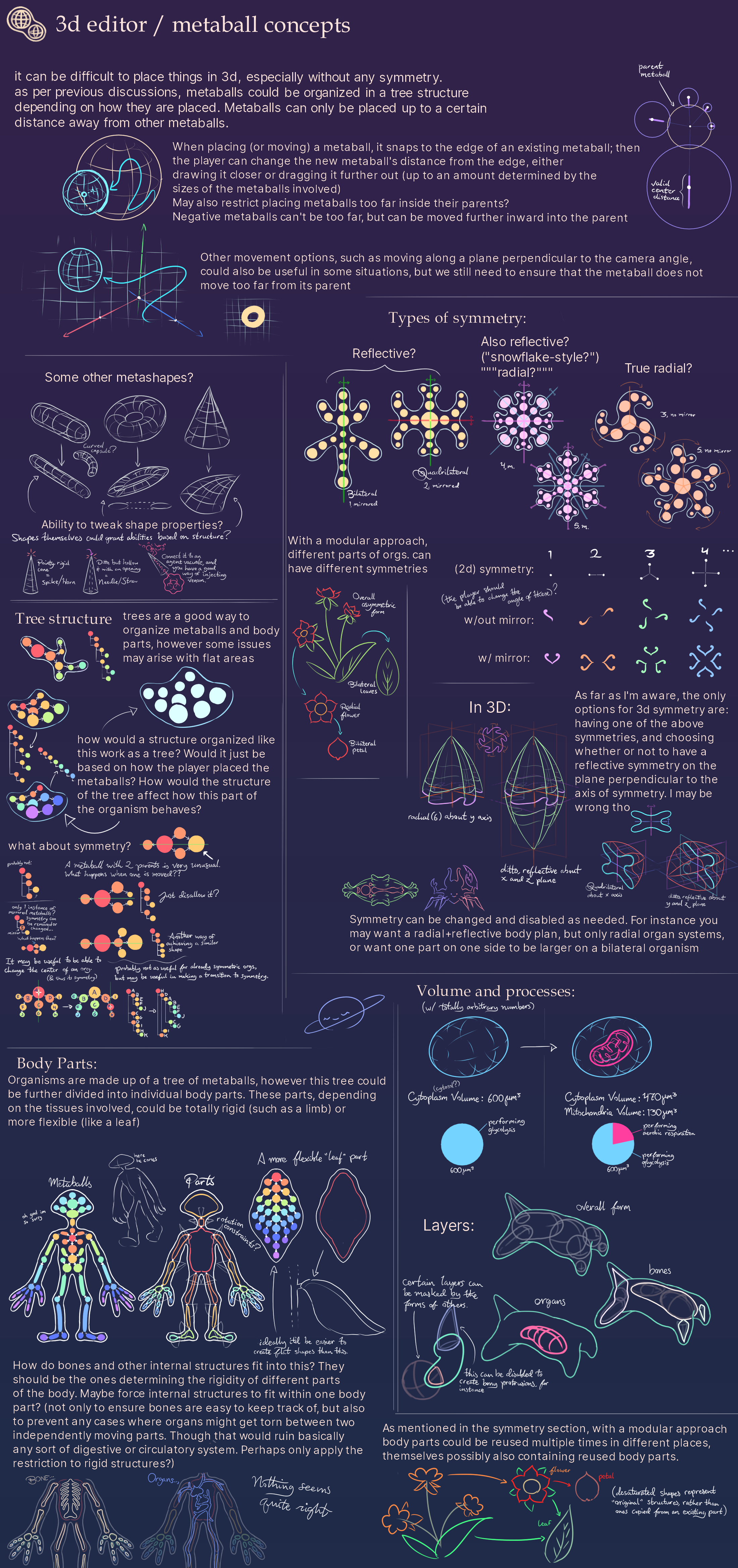
Joints and segments seem like a reasonable way of implementing limbs, but I think we do need to be careful about how they’re evolved. It shouldn’t be too easy to evolve new limbs or joints out of nowhere, instead new limbs should be repurposed from existing structures if possible (likely developed in early multicellular, when adding new structures is easier?) However, it might also need to be skewed in the player’s favor, since getting onto land is a very important part of the game and getting stuck because you just don’t have the any parts to adapt into limbs isn’t going to be fun.
I thought that joints and segments might be able to be used to create necks, but starting with a head on the abdomen and then moving it to an appendage at the end of a segment is probably not the best way of doing so. Since the abdomen is sculptable and potentially flexible, the head part could be extended from the rest and given muscles to help it move around, but that introduces areas of different flexibility and movement on the same body of tissue, which also seems tricky to figure out.
Perhaps in organisms with a “front,” the abdomen (which is becoming an increasingly unfitting word as I keep coming up with these ideas) can be segmented, creating different portions with different properties.
(warning: i am now rambling)
For instance you could have a core (abdominal!) segment, which is rigid and sturdy, then a neck at the front, which is longer and flexible (or also rigid, but has muscles to move it around at the base), etc.
And maybe segments could be duplicated (like how centipedes grow), giving you copies of it and whatever parts were on it for much cheaper than it would be to just extend your body and remake the parts from scratch. This ability would be very easy to exploit though, so maybe it should be limited?
…Though perhaps auto-evo might do all the work, because I was thinking of a human-sized organism duplicating its “leg” segments to get several more, but having that many legs would be a bad move and a waste of energy and resources.
But also, consider an imbalanced organism with just one pair of legs, which would be benefited by another pair. It seems unrealistic for it to just duplicate its legs; realistically it would probably try to adapt other structures or just try to balance itself better. So maybe duplication could be another thing that’s easier at the early multicellular scale? Should there really be one point where stuff like that just stops being possible? I am using segmentation to describe two totally different ideas, one being a feature present on arthropods in real life, the other being a way to divide the core body, already an abstraction, because I’m too lazy to figure out how different parts of it might behave differently, so they might not really be compatible ideas.
(actually what am i saying i’m always rambling but now i am going to ramble about something else)
How would tentacles work? Would they be separate parts from limbs? I remember something from the GDD, I think, about a part called “wormacles,” which could be used for both tentacles and worm-like bodies. Could an abdomen be a wormacle? Or would all wormacle-like parts just have some flexibility setting turned up? In which case, tentacles would be flexible limb segments, or some other extension? They could just be flexible, muscle-filled “spikes,” which would just be long structures that taper to a point at the end. The flexibility of a tentaspike would make it soft and able to grasp stuff, but a spike made of a more rigid material could serve as an impaling weapon.
I’m finally out of ideas, but I’d like to suggest these videos by Biblaridion:
Alien Biospheres: Part 2 - Early life and Body Plans
Alien Biospheres: Part 3 - Cladistics and Ecology
They’re pretty relevant to this topic, and they go over body plans, cephalization, segmentation, and the adaptation of existing structures into new ones, and they might give you an idea of how early life could develop and set the stage for more complex organisms.